
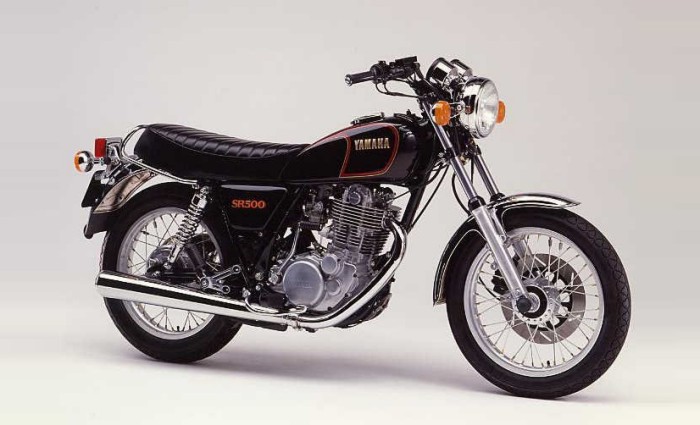

Yamaha SR500
In the late 1970s, the motorcycle world was obsessed with high-tech advancement. Multi-cylinder engines, complex electronics,
and heavy liquid-cooling systems were rapidly becoming the industry standard.
Then, in 1978, Yamaha did something delightfully stubborn. They released the Yamaha SR500.
Instead of chasing the future, Yamaha took a step back to celebrate the raw, mechanical essence of motorcycling. They built an unapologetic, air-cooled, kickstart-only single-cylinder street bike. It didn’t just survive the era; it became an immediate cult classic and a foundational pillar of modern custom motorcycle culture.
The Heart: The Quintessential Big “Thumper”
To understand the SR500, you have to understand its engine. The bike borrows its rugged architecture directly from Yamaha’s legendary XT500 dual-sport—the dirt bike that won the first-ever Paris-Dakar Rally.
Yamaha reworked this powerplant for the street, creating a 499cc four-stroke single-cylinder engine that riders affectionately call a “thumper” because of the deep, rhythmic pulse it sends straight through the chassis.
Key Mechanical Specs:
-
Engine: 499cc air-cooled SOHC single-cylinder, 2-valve
-
Power Output: ~31.5 horsepower @ 6,500 RPM
-
Torque: 26.8 lb-ft @ 5,500 RPM
-
Weight: An incredibly nimble 158 kg (348 lbs) dry
-
Oil System: Dry sump design, ingeniously using the frame’s down-tubes as the oil reservoir to keep the bike’s profile ultra-slim.
With just over 31 horsepower, the SR500 won’t win any drag races. However, the torque hits low and wide. It squeezes out of corners with a characterful grunt, and its featherweight chassis makes it an absolute weapon for slicing through heavy city traffic or tossing into tight, winding country lanes.
The Art of the Kickstart
There is no electric starter button on an SR500. If you want to ride it, you have to wake it up yourself.
For the uninitiated, kickstarting a massive 500cc single-cylinder piston can be a recipe for a sprained ankle. But Yamaha engineered a beautifully mechanical solution to make the process a graceful ritual rather than a wrestling match:
-
The Decompression Lever: A small trigger beneath the left handlebar lets you manually open the exhaust valve slightly to bleed off pressure.
-
The Sight Glass: A tiny window on the right side of the cylinder head reveals a silver indicator indicator bar.
When you slowly nudge the kickstarter until the silver bar lines up perfectly in the sight glass, you know the piston is positioned just past Top Dead Center (TDC). Release the lever, let the kickstarter return to the top, give it one smooth, authoritative swing with zero throttle, and the engine fires up with a mesmerizing ka-thunk-ka-thunk idle.
The Customizer’s Holy Grail
While it began life as a reliable, commuter-friendly standard roadster, the SR500’s minimalist design eventually turned it into a legend among custom builders.
Because the bike is essentially just a fuel tank, a straight backbone frame, and a beautiful engine block, it acts as a perfect blank canvas. It has been stripped down and rebuilt into virtually every sub-genre of custom motorcycling.
If you want to build a vintage Cafe Racer, you just drop the handlebars to clip-ons, swap out the bench for a solo cowl seat, and fit a swept-back exhaust. Want a rugged Scrambler or a sleek Street Tracker? Throw on a set of wide bars, high-clearance fenders, and knobby tires. The simplicity of the wiring harness and engine means almost anyone with a basic set of wrenches can completely reinvent the machine in their own garage.
Why It Endures
The SR500 stayed in production across global markets until 1999 (and its smaller sibling, the fuel-injected SR400, carried the torch all the way until 2021).
In an age dominated by riding modes, digital displays, and complex engine control units, the Yamaha SR500 remains a refreshing sanctuary. It offers an unfiltered, highly tactile connection between rider and machine. It is a motorcycle that demands a bit of discipline to start, rewards you with endless mechanical personality when you ride it, and asks for very little more than clean oil and a twisty road in return.